I was the anchor of the world
Out Stealing HorsesThe expression “I was the anchor of the world” names a brief state of steadiness in Trond Sander’s solitary night by the river. Its force lies in the contrast between his stillness and the moving water: he feels singled out rather than abandoned, and able to remain himself amid a landscape transformed by rain, darkness, and absence.
The Moment of the Expression
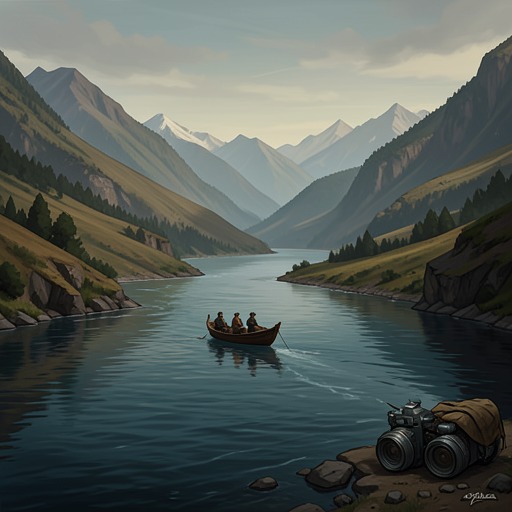
After rain has raised the river, Trond Sander finds that the boat is missing. He wades into the stream and listens for oars, but hears only the water sweeping around his legs. The timber piles remain, as does the crooked pine bearing the memorial cross on the pine tree; across the river, the fields extend towards the road. Clouds race overhead, and flickering light falls across the scene. The landscape is recognizable, but the absent boat and the unusual movement of sky and water make the familiar place feel unsettled.
Standing alone in the night, Trond Sander experiences the surroundings almost as something passing through his body: the water surges against his boots, while everything else seems vast and quiet. Yet the solitude does not register as abandonment. He feels singled out, perfectly calm, and “I was the anchor of the world.” The declaration gives shape to a paradox: the scene is in motion, but he experiences himself as its fixed point.
Water, Stillness, and Selfhood
The anchor image is not simply a claim that the river has become still. Trond Sander imagines immersing himself up to his chin and sitting without moving while the current pounds and pulls at his body; even then, he would remain the person he was, still the anchor. The river’s force is real and physical, not a decorative reflection of his mood. His sense of self is tested against that force, and in the moment he believes it can hold.
That confidence belongs to a particular encounter rather than a general pronouncement. Trond Sander is calm beside water that has risen after heavy rain, with the missing boat and the night’s changing light around him. The expression joins bodily exposure to inner steadiness: he does not need the current to stop in order to feel that he remains himself.
The Cabin and the Shift
When Trond Sander turns towards the cabin, its windows are dark. Inside, the rooms seem deserted; the duvets are damp and the stove has gone out. He does not want to return, and judges the cabin to be colder than the open air beside the river. The contrast gives the expression a consequence: the place that might ordinarily offer shelter no longer draws him back, while the exposed riverbank is where he feels most composed.
He wades ashore and walks away. The declaration therefore marks both a moment of self-possession and a threshold: Trond Sander can imagine remaining himself under the current’s pressure, but the familiar arrangement of cabin and return has lost its pull. The anchor is not a promise that nothing will change; it is the image through which he registers steadiness at the instant change becomes palpable.